








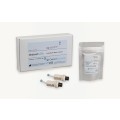
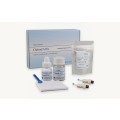

Description
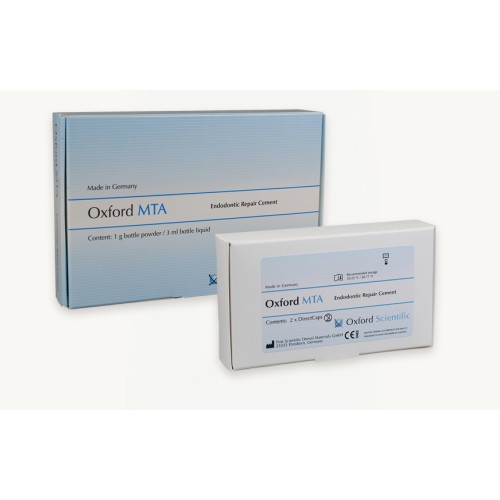
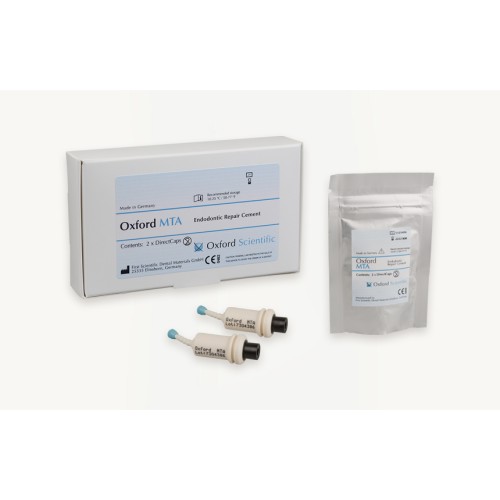
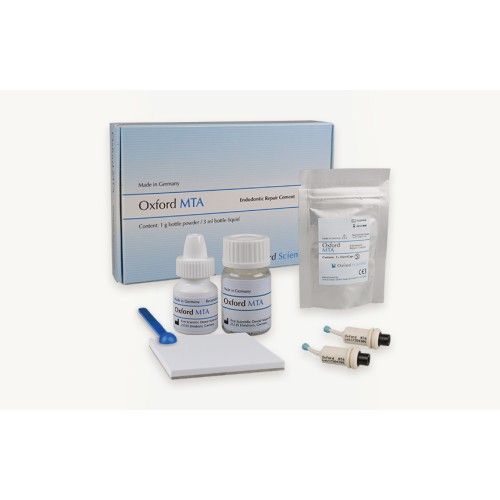
Oxford MTA is an endodontic repair cement. Oxford MTA powder is consisting
of very fine hydrophilic particles of several mineral oxides. After contact with
Oxford MTA liquid it forms a gel that hardens to an impermeable barrier.
1. Indications
· Repair of root perforations during root canal therapy
· Root-end filling (retrograde)
· Pulp capping
· Root-end filling (orthograde)
2. Contraindications
Not known
3. Side effects
Not known
4. Dispensing and Mixing
The powder/liquid ratio is 2.6/1.0. This can be obtained by mixing 1 level (blue) scoop of powder and 2 drops of liquid.
Activate and mix the Capsule according to the information in the Capsule instruction.
Mixing time for the Capsules is 30 seconds.
5. Application
5.1. Repair of root perforations
- Place rubber dam and clean the root canal system using intra-canal instruments and irrigate with NaOCl.
- Dry the root canal with paper points and isolate the perforation.
- Fill the apical canal space up to the perforation completely with a suitable root canal filling material.
- Mix Oxford MTA as described under point 4 and extrude it on a glass plate.
- Apply Oxford MTA with suitable instruments into the perforation site and condense it.
- Check the position of Oxford MTA in the root canal by an X-ray. If an adequate barrier has not been created, rinse Oxford MTA out of the canal and repeat the procedure.
- Remove excess moisture with a damp cotton pellet or a paper point.
- Place a damp cotton pellet in the access to the root canal and apply a temporary filling material.
- Alternatively seal the access preparation with a suitable root canal filling material and seal the cavity with a tight filling.
- Both options can be done not before 5 minutes after placement of the Oxford MTA.
- Oxford MTA repair material remains as a permanent part of the root canal filling.
5.2. Root-End Filling (retrograde)
- Create an access to the root-end and resect the root with a surgical bur.
- Use an ultrasonic tip to prepare a class I root-end cavity preparation to a depth of 3-5 mm.
- Isolate the area and dry the root end cavity with paper points.
- Achieve hemostasis with suitable methods.
- Mix Oxford MTA as described under point 4 and extrude it on a glass plate.
- Apply Oxford MTA with suitable instruments and condense it using a small plunger.
- Remove excess cement and clean the surface of the root with a moist piece of gauze.
- Confirm placement of the Oxford MTA repair material with an X-ray. The Oxford MTA repair material remains as a permanent part of the root canal filling.
5.3. Pulp Capping
- Place rubber dam and prepare the cavity outline. If caries is present, remove it.
- Rinse cavity and exposed pulpal areas with a suitable disinfectant.
- Mix Oxford MTA as described under point 4.
- With a suitable instrument apply a small amount of Oxford MTA over the exposed pulp and remove excess moisture with a dry cotton pellet.
- Not before 5 minutes after application of Oxford MTA place a small amount of a flowable light cure liner (e.g. Oxford Iono VLC) and light cure.
- Etch the remaining cavity walls according to the total-etch-technique with Oxford Etch and apply a suitable bonding agent (e.g. Oxford Bond TE Mono) according to the corresponding instructions.
- Place a light cure composite (e.g. Oxford Ceram NANO) according to the instructions and light cure.
- Pulp vitality and status should be checked by X-ray at regular intervals.
5.4. Root End Filling (orthograde)
- Place rubber dam and clean the root canal system using intra-canal instruments and irrigate with NaOCl. Dry the root canal with paper points.
- For disinfection place calcium hydroxide paste in the root canal for one week.
- Seal the access opening with a temporary filling material.
- Mix Oxford MTA as described under point 4..
- With a suitable instrument apply a small amount of Oxford MTA into the apical region and condense it. Create a 3 – 5 mm barrier of Oxford MTA.
- Check the position of Oxford MTA by an X-ray. If an adequate barrier has not been created, rinse Oxford MTA out of the canal and repeat the procedure.
- Remove excess moisture with a damp cotton pellet or a paper point.
- Place a damp cotton pellet in the access to the root canal and apply a temporary filling material.
- Alternatively seal the access preparation with a suitable root canal filling material and seal the cavity with a tight filling.
- Both options can be done not before 5 minutes after placement of the Oxford MTA.
- Oxford MTA repair material remains as a permanent part of the root canal filling.







0 Review for “OXFORD MTA | Mineral-Trioxide-Aggregate Endodontic Cement”
5 Stars
0%
4 Stars
0%
3 Stars
0%
2 Stars
0%
1 Stars
0%